
A ground-level terrace placed on natural soil generates neither ground coverage nor floor area. However, from a tax perspective, it may still increase the rental value of the property, and thus the property tax. The confusion between urban planning obligations and tax obligations traps many owners each year who believe they are compliant after simply pouring a slab without any formalities.
Undeclared terrace and home insurance: exclusion clauses to know
Multi-risk home insurance contracts cover dependencies and outdoor developments declared in the property description. An undeclared terrace to the insurer constitutes an omission that alters the risk assessment.
In the event of a claim (storm, water damage, collapse), the appointed expert checks the administrative compliance of each affected structure. If the terrace has not been subject to either a prior declaration of works or a tax declaration, the insurer may invoke a concealment or false declaration under Article L113-8 of the Insurance Code. The consequence ranges from a proportional reduction in compensation to the outright nullification of the contract concerning the claim.
Since 2024, we have observed a clear trend: insurers now cross-reference cadastral data with asset declarations submitted by policyholders. The discrepancy between the declared built area in the land registry and that stated in the contract triggers an automatic alert. To declare a terrace for tax purposes correctly, it is therefore essential to consider the insurance implications as much as the tax implications.

Taxable area of a terrace: technical criteria that trigger taxation
Only terraces that create ground coverage or floor area are included in the calculation of rental value. In practice, three technical parameters determine the crossing of this threshold.
- The height relative to the natural ground: a raised terrace over 60 cm generates ground coverage. Bioclimatic modular terraces exceeding 1.80 m of effective height are now classified as a closed and covered construction, a regulatory change integrated in 2026.
- The covering: a terrace covered by a fixed pergola, awning, or rigid roof enters the taxable area as long as the structure is permanent. Retractable fabrics are not subject to this, unless they are permanently fixed.
- The removable or permanent nature: administrative courts increasingly classify composite wood terraces as “perpetually fixed,” despite their removable appearance. This jurisprudence increases the number of terraces requalified as constructions subject to declaration.
A ground-level terrace, uncovered, placed directly on the ground without foundation or elevation, generally does not create either ground coverage or floor area. It does not alter the rental value. Nevertheless, we recommend checking the local urban planning regulations, as some local rules require a prior declaration even for this type of structure.
Tax declaration of a terrace: form and deadline with the tax authorities
The tax declaration is distinct from the urban planning authorization. Even if the town hall has validated the prior declaration of works, the owner must notify the completion of the construction to the property tax office within 90 days.
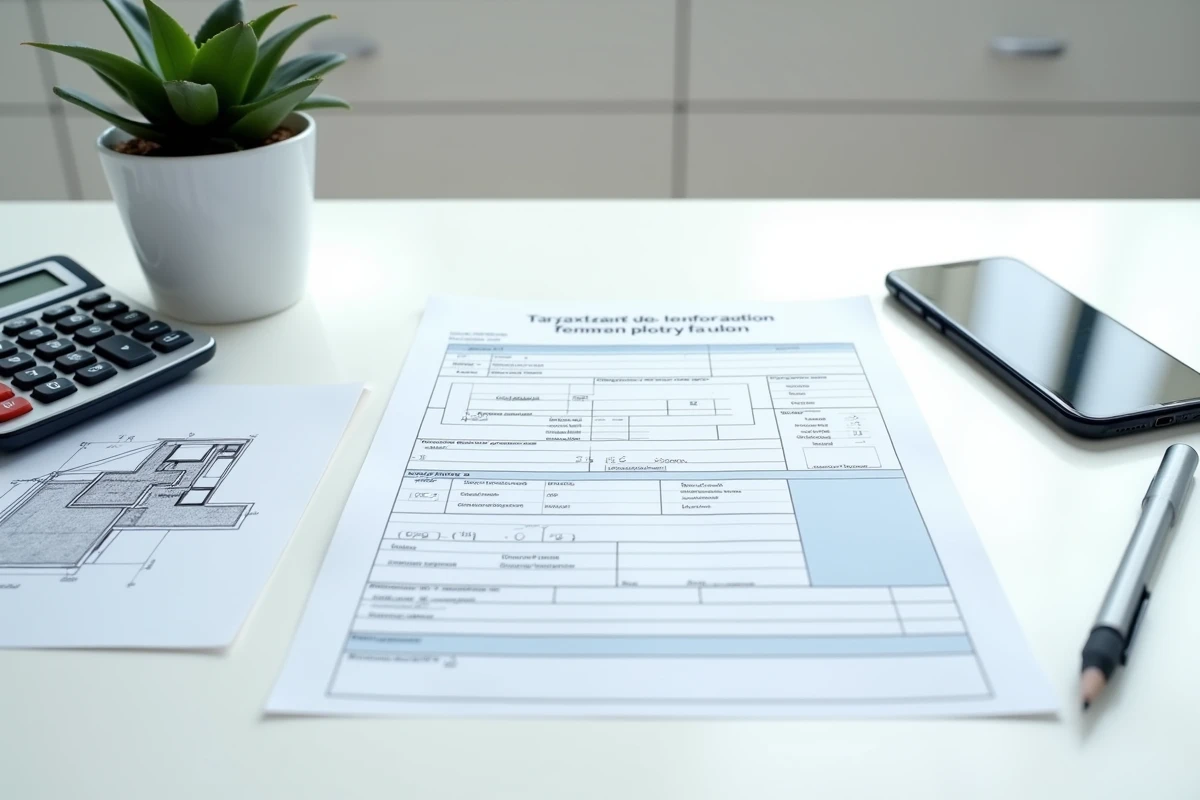
The form to be used is model IL (6704 for built properties, 6703 for changes in consistency). This document allows the administration to recalculate the cadastral rental value of the property, which is the basis for calculating property tax and, where applicable, the housing tax on second homes.
Temporary exemption from property tax
A terrace declared within 90 days of completion could historically benefit from a property tax exemption for two years. This exemption tends to be systematically denied in high-demand areas, as local authorities seek to limit the budgetary impact. In low-demand areas, the exemption remains theoretically applicable, but we observe a tightening of the conditions for granting it.
Automated checks using aerial imaging
Since 2024, the tax administration has been extensively using aerial imaging combined with cross-referencing cadastral data to detect undeclared constructions. Covered terraces, swimming pools, and extensions appear in satellite images and are compared to existing property declarations. Notices for undeclared terraces have multiplied, including for ground-level structures with permanent covering.
Sanctions and regularization of an undeclared terrace with the town hall and tax authorities
The absence of a declaration exposes one to two distinct types of sanctions, one related to urban planning and the other to tax law.
From an urban planning perspective, construction without authorization constitutes a criminal offense. The fine may be calculated per square meter of irregularly constructed area, and the court may order restoration, meaning demolition.
From a tax perspective, the adjustment applies to non-prescribed years (generally the last four). The administration recalculates the property tax owed by including the terrace in the rental value. Late penalties and an increase for late declaration are added to the principal.
Voluntary regularization
Regularization is possible at any time. It involves two parallel steps:
- Submitting a prior declaration of works (or a building permit if the area exceeds the applicable threshold) to the town hall to regularize the situation regarding urban planning law.
- Sending the property tax office the change of consistency declaration form, accompanied by plans and photos of the existing structure.
- Updating the property description with the home insurer to avoid any exclusion of coverage in the event of a future claim.
Spontaneous regularization reduces tax penalties and eliminates the risk of criminal prosecution if the town hall accepts the compliance of the structure with the current local urban plan.
An owner who builds a terrace without anticipating these three aspects (urban planning, taxation, insurance) exposes themselves to a cumulative financial consequence far exceeding the cost of the terrace itself. The declaration, as tedious as it may seem, remains the only complete legal protection.